
Water Treatment
Sediment Filters for Well Water in Western NC
A sediment filter is for sand, grit or cloudy water at the taps. Case Water Systems finds where it is coming from, then installs a whole-house filter matched to the load.
Fully licensed and insured. Work is performed onsite by a licensed contractor.
Sediment filters
What to notice before you call
- When did it start? After a storm, pump work, a power outage or a long time unused?
- Does it clear up after the water runs a while, or stay gritty?
- What does it look like? Sand, clay cloudiness, rust flakes or black grit each point somewhere different.
- Hot side only? That can be the water heater.
- Is it getting worse? A sudden change can mean a well or pump problem a filter won’t fix.
Find the cause first
Sediment in mountain well water is usually one of a few things. Fine sand or silt can come in through the well itself, especially where the casing does not reach far enough into solid rock. Clay can cloud the water after heavy rain on shallow wells and springs.
Rust flakes can come from old galvanized pipe or a deteriorating steel casing. And grit can show up after pump work, a power outage or a long period with no use, when the water level moves and stirs things up. Each one points to a different fix.
Silt that clouds the water after every storm is a sign surface water may be reaching the well, which is a wellhead problem first. Sand that grinds through faucets may mean the pump is set too close to the bottom or is pulling too hard. A filter handles normal sediment, but a sudden change can point to a well or pump problem that a filter will not fix. See well diagnostics and spring water systems.
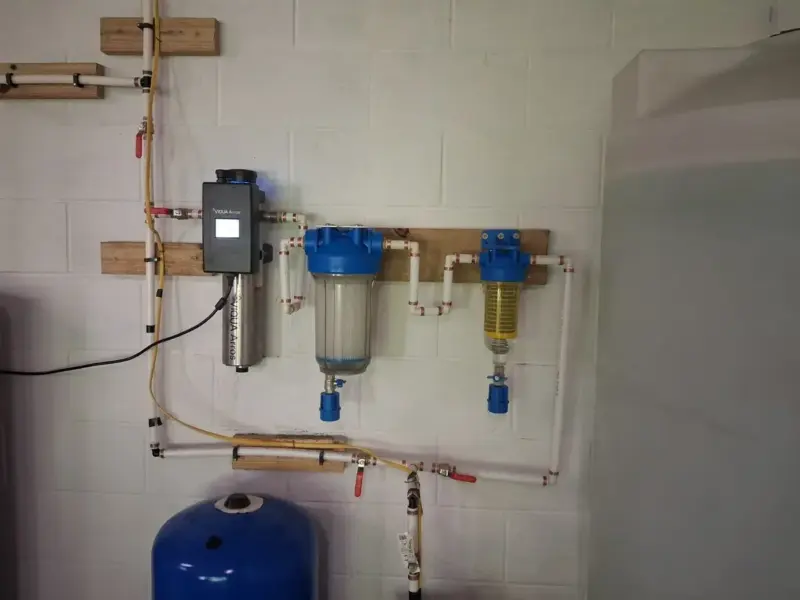
Spin-down screens, cartridges and backwashing filters
A spin-down screen is a clear housing with a fine mesh and a flush valve at the bottom. It catches sand and grit before it reaches the pressure tank, and you can see and flush what it catches. Cartridge filters catch finer particles.
They are simple to run, but they clog quickly when the load is heavy, and a clogged cartridge drops pressure in the house. Backwashing media filters suit wells with a steady load of fine sediment, where cartridges would need changing too often; they need a drain and enough flow to backwash. We size the equipment to the flow and the type of sediment.
Protecting the rest of the system, and when the sediment changes
Sediment wears pump impellers and check valves, settles in the pressure tank, clogs faucet screens and fouls UV sleeves and softener resin. Putting the right filter in the right place protects all of that. On a home with UV, a fine filter ahead of the lamp is a must, since particles can shield bacteria from the light.
See UV water treatment. A filter is not a substitute for fixing a well that is pulling in surface water. If cloudy water follows rain, have the water tested for bacteria. See water testing and well chlorination.
If a well that has always been clear suddenly starts producing sand or mud, do not just change the filter more often. A sudden change can mean the pump has dropped, the water level has fallen, or the casing has a new problem. A look at the pump, and a well camera inspection when it is warranted, may find the cause before it damages the equipment. Need a new well drilled? We can refer you to a driller we trust, then handle the pump, pressure tank and water system from there.
Common sediment filter questions
Why is there sand in my well water?
Sand can come from the well, from a pump set too close to the bottom, or from a damaged component. If it started suddenly, have the well and pump checked rather than only changing the filter more often.
Will a sediment filter protect a UV system?
Yes. UV works best on clear water, so sediment filtration is usually installed ahead of the UV unit.
My water gets muddy after rain. What does that mean?
Water that changes after rain can mean surface water is reaching the source, which is common with springs and with wells that have a damaged cap or poor wellhead protection. We can inspect the source and recommend testing. A filter alone will not fix that.
Why does my pressure drop between filter changes?
Every filter causes some pressure drop, more as it loads up. If pressure falls off between changes, the filter is doing its job but may be undersized for the sediment load. We can check pressure before and after the filter and show you how to change cartridges or flush a screen.
Do you hook up new wells if the well itself is the problem?
Need a new well drilled? We can refer you to a driller we trust, then handle the pump, pressure tank and water system from there. We also diagnose and service existing wells, pumps and treatment.
Tell us what you are seeing in the water
Send the address, whether the water is sandy, rusty or cloudy after rain, and whether it started suddenly or has always been there.