
Well Maintenance
Start with what sits above ground
To protect a well from freezing in Western North Carolina, start with the pipe and equipment above ground. The first hard freeze does not send a warning. Most of the no-water calls we take on a cold morning have nothing to do with the well itself. They come from a few feet of pipe, a pressure switch, or a spring line that sat out in the wind all night. Almost all of it can be headed off before winter.
Before the first hard freeze
- Insulate the pressure switch and the short pipes around the tank.
- Close crawlspace vents and check the pump house heat.
- Wrap or drain exposed spring lines and yard hydrants.
- Know where the well pump breaker is, so you can shut it off if a pipe splits.
- Leaving for a while? Keep enough heat on, and have someone check the house.
Why mountain wells freeze, and what to protect
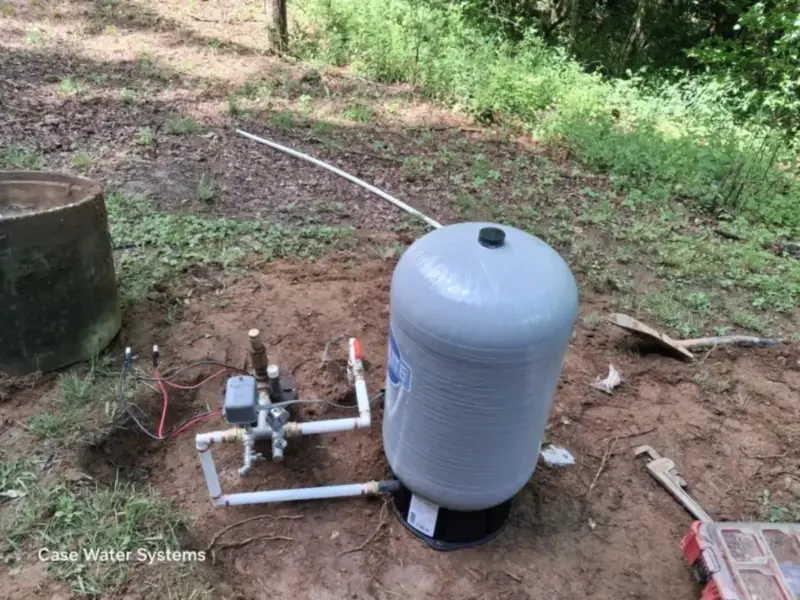
The water down in a drilled well stays well above freezing. Trouble starts at everything between the ground and your faucets. North-facing slopes, hollows that hold cold air, pump houses in the yard, and crawlspace tanks next to open vents are the usual weak spots. Plenty of homes here also run off a spring, with a gravity line that runs a long way through the woods.
If we had to pick one part that causes the most freeze calls, it is the pressure switch: the small gray box on the pipe near the tank. Insulate the switch, the short tube under it and the exposed pipe, and add heat tape where it fits. Do not wrap the switch so tightly that you cannot tell if it is icing up.
Close crawlspace vents, seal obvious drafts, and keep a little heat in the pump house on the coldest nights. Keep the well cap tight and the wellhead clear of leaves and drift so meltwater does not sit against the casing. Spring lines that run shallow through the woods should be insulated or buried where you can.
During a cold snap, and what protection cannot do
If you wake up with no water in freezing weather, check the pressure gauge, the pump house or crawlspace, and the switch before you assume the pump has failed. A frozen switch tube looks a lot like a dead pump. Do not apply an open flame to pipe or a tank.
Once things thaw, listen for the pump and watch the gauge. If a fitting has split, or the pump is running with no pressure, call us. See pressure tank problems and what to do when your well has no water.
We can prepare a system for winter and repair freeze damage, including at vacant and seasonal homes. Winterization cannot guarantee that nothing will freeze if heat is lost or a line is not buried deep enough. We are honest about what protection can and cannot do. See well maintenance.
Questions we get about this
Can a drilled well freeze?
Deep in the well, the water doesn’t get cold enough to freeze. Trouble starts at everything between the ground and your faucets: the pipe coming out of the casing, the pump house, the tank in a vented crawlspace, and a line that crosses a ditch or comes out of a bank.
Why does the pressure switch freeze first?
The pressure switch is a small box on the pipe near the tank. The short tube under it and the nearby fittings are light and exposed, so they ice up before the tank itself freezes solid.
Is heat tape safe in a pump house?
Heat tape can help on exposed pipe when it is installed to the manufacturer’s directions and kept away from clutter. A thermostatically controlled heater, set safely away from wood and insulation, is often the better way to keep a pump house just above freezing.
Can a spring line freeze?
Yes. Spring lines that run shallow through the woods freeze in a hard snap. Insulate exposed pipe, bury what you can, and keep storage tanks and lids tight.
Do you come out for frozen wells and no-water calls?
Yes. Call (828) 222-4160. Arrival depends on the schedule, weather and how remote the property is. After a freeze we thaw, test and fix the real problem, which is not always the pump.
Want the system looked at before the first hard freeze?
Share the property address and whether this is a winterization visit or a no-water call. We’ll call or text to confirm a time. If you have no water, call (828) 222-4160.