
Short Cycling
Pressure Tank Replacement in Asheville, NC
On a short-cycling or pulsing pressure tank around Asheville, Case Water Systems tests the tank, tells you whether it can be recharged or replaced, and sizes a new tank to the pump and house.
Fully licensed and insured. Work is performed onsite by a licensed contractor.
Asheville pressure tanks
How to tell if the tank has gone bad
Stand by the tank, open a faucet, and watch. Short cycling is the usual sign: the pressure switch clicks on, then off a few seconds later, over and over. The gauge needle may swing from low to high in seconds instead of climbing and falling slowly, and the shower may go strong, weak, strong.
Press the small valve on top of the tank, like a tire valve: air should come out. If water does, the bladder has failed. Rap on the side from top to bottom; the top should sound hollow.
If it sounds solid all the way up, the tank is waterlogged. A tank that is rusted through or leaking at the bottom seam is done. See pressure tank problems.
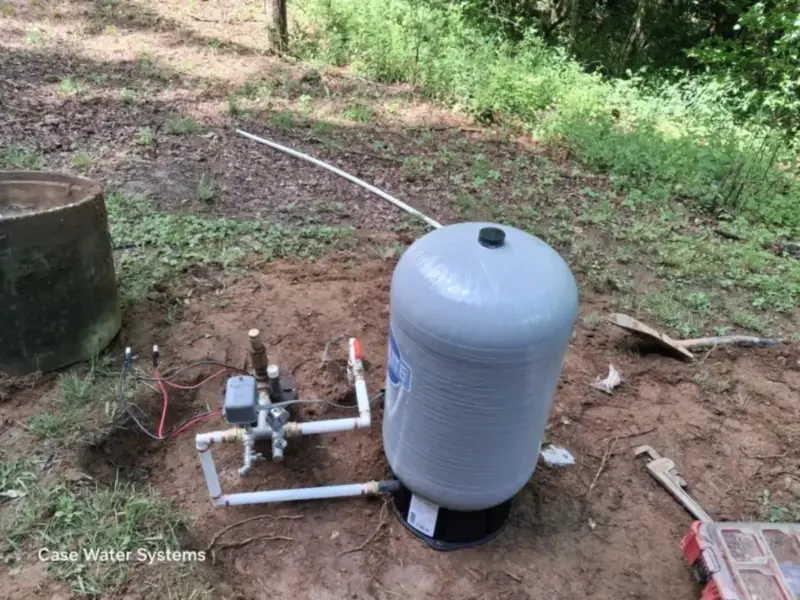
Tank, switch or pump?
These three work together, and when one acts up the others take the beating. A bad tank makes the switch chatter and the pump start too often. A pitted pressure switch can mimic a tank problem.
A tired pump can leave you with weak pressure that no tank will fix. We check the tank’s air charge with the system drained down, look at the switch contacts and settings, and watch the pump run. Then we tell you which part is actually at fault.
If a low air charge is all that is wrong, recharging the tank can put it back in service. If the bladder has ruptured or the tank is rusted through, it needs to be replaced. Most modern well tanks are not built to have the bladder swapped.
Asheville homes, sizing and the swap
We work on tanks in all kinds of setups around Asheville: old galvanized tanks in farmhouse basements in Leicester and Sandy Mush, tanks in crawlspaces under houses on the slopes of West Asheville and Fairview, and tanks in small well houses toward Weaverville and Barnardsville. Older galvanized tanks without a bladder need their air recharged over and over; swapping to a modern bladder tank usually ends that chore. A tank in an unheated well house or a drafty crawlspace can freeze and split in a hard cold snap.
Many area homes have a tank that is smaller than ideal for the pump it is paired with, often because it was the size that fit the space. When we replace one, we look at the pump, household use and floor space. Sometimes going one size up is the best thing you can do for the life of the pump.
We set the new tank’s air charge to match the switch before it ever sees water, check the tee, gauge and relief valve, haul off the old tank, and watch a few full pump cycles before we leave. Tell us if the tank sits in a tight crawlspace or a hard-to-reach well house so we can plan for it. See pressure tank replacement and Asheville.
Questions people ask us about pressure tanks
How do you know if you have a bad pressure tank?
The usual signs are the pump clicking on and off every few seconds while a faucet runs, pressure that surges and drops, a gauge that jumps fast between the low and high setting, and water coming out of the air valve on top of the tank. If the tank sounds solid all the way up when you rap on it, it is waterlogged.
Can a pressure tank be repaired, or does it have to be replaced?
If the air charge is just low, recharging the tank to the right pressure can put it back in service. If the bladder inside has ruptured, or the tank is rusted through, it needs to be replaced. Today’s tanks generally aren’t made for a bladder replacement.
What happens if I keep running a bad pressure tank?
The pump short cycles, starting and stopping far more often than it was built to. That heats the motor and wears the pressure switch contacts, and it is one of the most common reasons a well pump gets replaced early.
Should I go bigger when I replace my pressure tank?
Often it makes sense. A larger tank gives longer pump run times and fewer starts. We size it to your pump, your house and the space you have.
Is a bad pressure tank the same as low water pressure?
Not always. Low pressure can come from the tank, the pressure switch, a clogged filter, a failing pump or a well that is struggling. We test before replacing anything. See low water pressure.
Think your pressure tank is shot?
Send the address, what you hear at the tank, and whether water comes out of the air valve on top.